
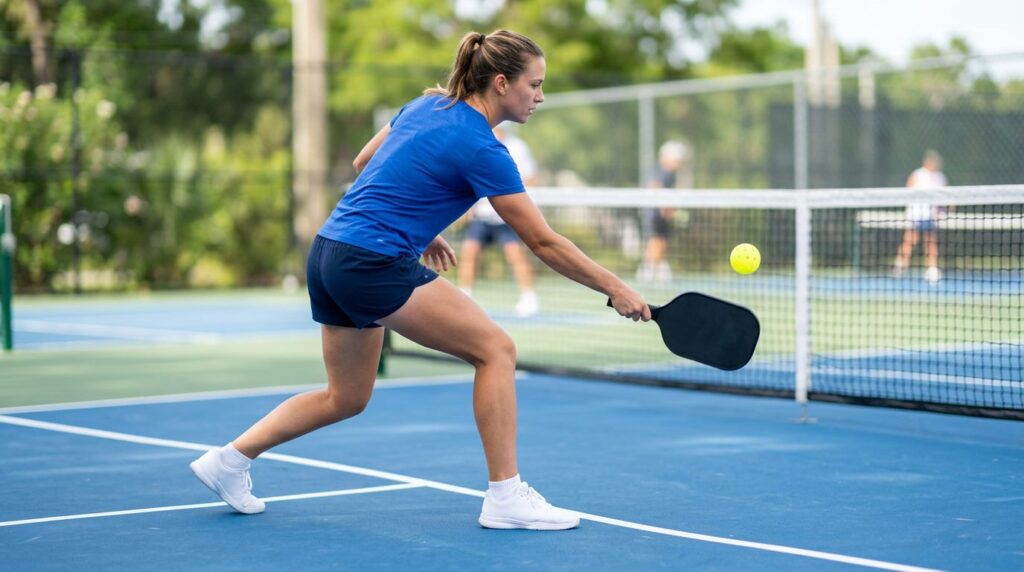
Pickleball serve rules are simple: a legal serve is hit underhand, from behind the baseline, diagonally into the opposite service court, and it must clear the kitchen. You can use a standard volley serve or a drop serve, where the ball bounces first. You get one attempt per serve. This guide explains every serve rule and then shows you how to hit a reliable serve.
Key takeaways
- Serve from behind the baseline, between the centerline and sideline extensions.
- Hit it diagonally so it lands in the opposite service court, past the kitchen line.
- Volley serve: upward arc, contact below the waist, paddle head below the wrist.
- Drop serve: drop the ball from your hand, let it bounce, then hit it.
- You get one attempt. A serve that clips the net and lands in is in play.
Where do you stand to serve?
At the moment you hit the ball:
- At least one foot must be on the ground behind the baseline.
- Neither foot can touch the baseline or the court inside it.
- Your feet must be between the imaginary extensions of the centerline and the sideline on your side.
Touching the baseline or stepping over it during contact is a foot fault. You can step onto the court after you hit the ball. You can find the exact lines in our court dimensions guide.
Where must the serve land?
The serve must go diagonally across the net and land in the service court opposite you. A ball that lands on the centerline, sideline or baseline of that service court is in.
The one line that doesn’t count is the kitchen line. A serve that lands in the kitchen or on the kitchen line is a fault. Read more in our kitchen rules guide.
What are the rules for the volley serve?
The volley serve is the traditional serve, hit out of the air. USA Pickleball’s rulebook sets three requirements:
- Upward arc. Your arm must move in an upward arc when you hit the ball.
- Below the waist. Contact must be made below your waist (the navel).
- Paddle head below the wrist. At contact, the highest point of the paddle head must not be above the highest part of your wrist.
These rules keep the serve underhand. You can’t serve overhead or sidearm in a way that breaks them.
What is the drop serve?
With a drop serve, you drop the ball from your hand, let it bounce on the court, and then hit it. The upward-arc, waist and paddle-head rules don’t apply to a drop serve, which makes it easier for many beginners.
- You must release the ball from your hand. You can’t toss it down, throw it upward or bounce it with force.
- You can’t add spin to the ball with your hand when you release it.
- The ball can bounce anywhere on the playing surface before you hit it. Most players let it bounce once beside them and then swing.
Other serve rules to know
- One attempt. If the serve is a fault, the serving player’s turn ends.
- Net serves are live. A serve that touches the net and lands in the correct service court is in play. It isn’t replayed.
- Call the score first. In doubles, the server calls the three-number score before every serve. See our scoring guide.
- Serve in time. The rulebook allows 10 seconds to serve after the score is called.
- No spin from your hand. Pre-serve spin, sometimes called the “chainsaw serve,” is not allowed. Spin can only come from the paddle.
- The two-bounce rule follows the serve. The return must bounce, and the serving team’s next shot must bounce too.
How to serve in pickleball
- Set up. Stand behind the baseline, sideways to the net, with your non-paddle shoulder pointing toward your target.
- Hold the ball in front. Hold it at about waist height, out in front of your body.
- Swing low to high. Start the paddle low and swing forward and up, like a pendulum.
- Contact in front. Hit the ball below your waist and in front of your front foot.
- Follow through toward the target. Finish with your paddle pointing where you want the ball to go.
Aim deep, close to the baseline. A deep serve pushes the receiver back and makes their return harder. Power matters less than consistency, because you only get one attempt.
Common serving mistakes
- Hitting above the waist. This often happens when beginners swing like a tennis serve.
- Stepping on the baseline. Leave a small gap behind the line.
- Serving short. Short serves land in the kitchen or give the receiver an easy return.
- Trying to hit too hard. A missed serve gives up your turn for nothing.
- Serving from the wrong side. Check your score: in singles, serve from the right when your score is even and from the left when it’s odd.
Practice drill
Put a towel or target in the back third of each service court. Serve 10 balls to each side and count how many land past the middle of the service court. Once you can land 8 out of 10, move the target closer to the corners.
Rules change from year to year. For tournaments, check the latest rulebook from USA Pickleball. For everything else you need for your first game, see our how to play pickleball guide and the pickleball terms glossary.
FAQ
Can you serve overhand in pickleball?
No. The volley serve must be hit with an upward arc, below the waist, with the paddle head below the wrist. That rules out an overhand serve.
Do you get two serves in pickleball?
No. Each server gets one attempt. In doubles, each partner gets a turn to serve before a side out, except at the start of the game.
What happens if the serve hits the net?
If it lands in the correct service court, it’s in play. If it lands in the kitchen or out of bounds, it’s a fault.
Is the drop serve allowed in tournaments?
Yes. The drop serve is part of the official USA Pickleball rules and is legal in sanctioned play.