
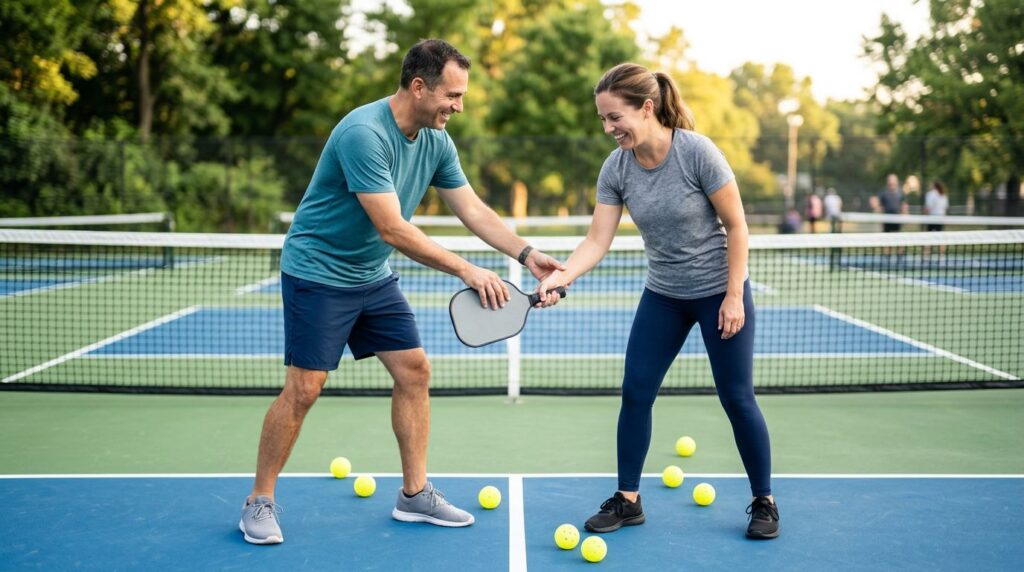
To play pickleball, you serve underhand diagonally across the net, let the ball bounce once on each side, then rally until someone hits it out, into the net or breaks a rule. Points are scored by the serving team, and games usually go to 11, win by 2. This step-by-step guide takes you from picking up a paddle to finishing your first game.
Key takeaways
- You need a paddle, a pickleball, a court with a net and, usually, three other players for doubles.
- Serve underhand and diagonally, past the kitchen.
- Let the ball bounce once on each side before anyone volleys.
- Don’t volley in the kitchen, the 7-foot zone by the net.
- After the first few shots, move up to the kitchen line. That’s where most points are won.
What do you need to play pickleball?
- A paddle for each player. A beginner paddle or a paddle set is fine to start.
- Pickleballs. Outdoor balls are harder with smaller holes; indoor balls are softer. Use the type made for your court.
- A court and a net. A pickleball court is 20 × 44 feet. Many parks have courts, and you can also tape one onto a tennis court or a driveway. See our court dimensions guide.
- Court shoes. Tennis or pickleball shoes are safer than running shoes for side-to-side movement. Our pickleball shoes guide explains what to look for.
Step 1: Set up the game
Most people play doubles, two players on each side. Each side of the court is split into a right and a left service court, with a 7-foot kitchen next to the net.
Decide who serves first, for example by a coin toss. The first serving team starts from the right-hand service court, and the score starts at 0-0-2. Our scoring guide explains why.
Step 2: Serve
- Stand behind the baseline on the correct side.
- Call the score out loud.
- Hit the ball underhand, with an upward swing, making contact below your waist.
- Aim diagonally into the service court across from you. The ball must clear the kitchen, including the kitchen line.
You get one serve attempt. If you miss, it’s a fault. A serve that touches the net and still lands in the right service court is in play. These steps follow the official USA Pickleball rules summary.
Step 3: Follow the two-bounce rule
After the serve, the receiving team must let the ball bounce before returning it. Then the serving team must also let the return bounce. After those two bounces, anyone can hit the ball in the air (a volley) or after it bounces.
That’s why the serving team usually stays back at the baseline for the first few shots, while the receiving team can move forward right after the return.
Step 4: Rally and respect the kitchen
Keep hitting the ball back and forth over the net. A rally ends when someone makes a fault, such as:
- Hitting the ball out of bounds
- Hitting the ball into the net
- Letting the ball bounce twice on your side
- Volleying while touching the kitchen or its line
- Volleying before the two bounces are done
The kitchen rule causes more beginner faults than anything else. You can step into the kitchen to hit a ball that bounced, but you can’t volley there. The full details are in our kitchen rules guide.
Step 5: Score points and rotate
If the serving team wins the rally, it scores a point and the server switches sides with their partner and serves again. If the serving team loses the rally, the serve passes to the partner, or to the other team after both partners have served. The receiving team never scores directly in traditional scoring.
The first team to 11 points wins, as long as it leads by at least 2.
Beginner strategy: where to stand and what to hit
- Move up after the two bounces. The team that gets both players to the kitchen line first usually has the advantage.
- Return serve deep. A deep return gives you time to move up to the kitchen line.
- Learn the dink. A dink is a soft shot that lands in your opponents’ kitchen. It’s hard to attack because it bounces low.
- Use the third shot drop. The serving team’s first shot after the return is often a soft drop into the kitchen, which buys time to move forward.
- Aim for the middle. In doubles, a ball between two opponents often causes confusion.
- Keep it in play. Most beginner points are lost on mistakes, not winners.
Pickleball etiquette
- Call your own lines. Each team calls balls on its side of the net. If you’re not sure, the ball is in.
- Call the score before every serve.
- Wait your turn. At busy courts, players often line up paddles in a rack to show who’s next.
- Tap paddles after the game. It’s a friendly way to say “good game.”
- Don’t walk behind a court during a point. Wait until the rally ends.
Where can you play?
Check local parks, recreation centers, YMCAs and tennis clubs, many of which now have pickleball courts or open-play sessions. Open play is the easiest way to start: you show up, add your paddle to the queue and get mixed in with other players.
Want more background? Read why it’s called pickleball, see how the sport compares in pickleball vs tennis, or keep our rules guide handy for your first game.
FAQ
How long does it take to learn pickleball?
Most people learn enough to play a game in one session. Getting consistent with dinks and drops takes longer, usually a few weeks or months of regular play.
Can you play pickleball with two people?
Yes. Singles uses the same court and rules, but you call only two numbers for the score, and you serve from the right when your score is even and from the left when it’s odd.
Do you have to serve underhand?
Yes. The serve must be underhand, with an upward motion and contact below the waist. A drop serve, where you let the ball bounce first, is also allowed.
What’s the most important rule for beginners?
The kitchen rule: never volley while touching the kitchen or its line. It’s the most common beginner mistake.