
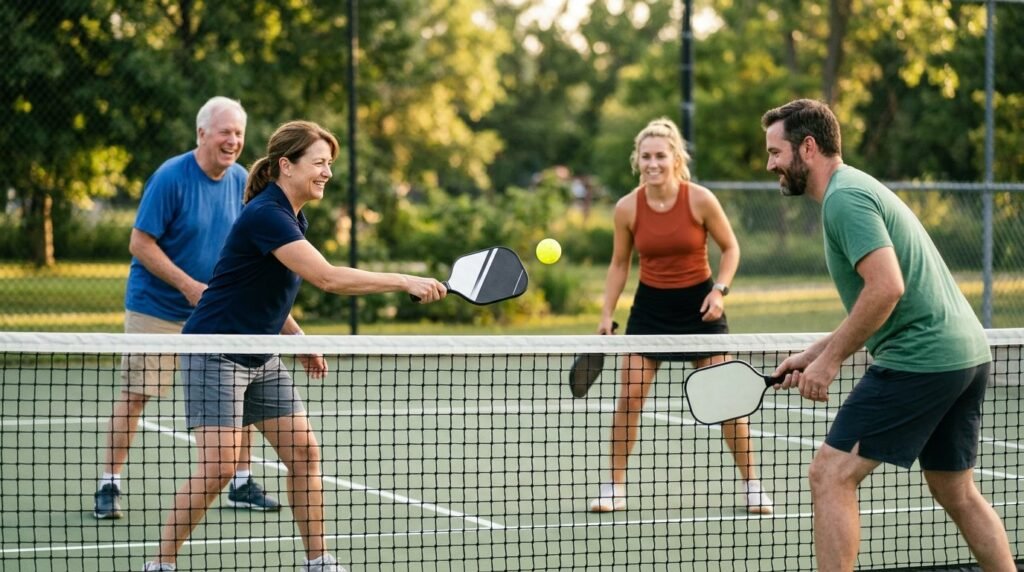
Pickleball is easy to pick up and hard to put down. You can learn enough to play your first game in a few minutes, and this guide covers everything you need: the court, the serve, the two-bounce rule, the kitchen and how to call the score.
The court
A pickleball court is 20 feet wide and 44 feet long, and it’s the same size for singles and doubles. The net hangs 36 inches high at the sidelines and dips to 34 inches in the middle.
The 7-foot zone on each side of the net is the non-volley zone, which everyone calls the kitchen. Behind it, a centerline splits each side into a right and a left service court.
The serve
Every point starts with a serve, and the rules are simple once you’ve seen them:
- Stand behind the baseline. At least one foot must stay on the ground behind the baseline when you hit the ball, and neither foot can touch the court or the baseline.
- Serve underhand. Swing in an upward arc and hit the ball below your waist.
- Serve diagonally into the opponent’s service court on the opposite side.
- Clear the kitchen. A serve that lands in the kitchen or on the kitchen line is a fault.
- One try per point. There’s no second serve.
Kitchen note
You can also use a drop serve: drop the ball, let it bounce, then hit it. The underhand and below-the-waist rules don’t apply to a drop serve, which is why many beginners find it easier.
If the serve clips the net and still lands in the correct service court, it’s in play. There are no “lets” on the serve.
The two-bounce rule
After the serve, the ball must bounce once on each side before anyone can hit it out of the air:
- The receiving team lets the serve bounce, then returns it.
- The serving team lets the return bounce, then hits it.
- From then on, either team can volley (hit the ball before it bounces) or play it off the bounce.
This rule keeps the serving team from rushing the net and makes rallies longer.
The kitchen
The kitchen rule only applies to volleys. You can’t hit a volley while you’re standing in the kitchen or touching the kitchen line. If the momentum of your volley carries you into the kitchen, that’s a fault too, even after the ball is dead.
You’re allowed in the kitchen at any other time. Step in to play a ball that has bounced, then step back out before you volley.
Kitchen note
A soft shot that lands in the kitchen is called a dink. Dink rallies, where both teams wait at the kitchen line for an attackable ball, are where most points between good players are won.
How scoring works
Games are usually played to 11, and you must win by 2. In traditional scoring, only the serving team can win a point. If the receiving team wins the rally, they don’t score, but they move one step closer to getting the serve.
In doubles, both players on a team get a turn to serve before the serve passes to the other team. Before each serve, the server calls three numbers: your team’s score, the other team’s score, then whether you’re server 1 or 2.
4Serving team
2Receiving team
1Server
When your team’s score is even, the player who started on the right serves from the right. When it’s odd, they serve from the left. Players switch sides only after their own team wins a point.
Kitchen note
Every doubles game starts at 0-0-2. The first serving team gets only one server before the serve passes over, so the game starts as if the first server has already had a turn.
In singles you call only two numbers, your score then your opponent’s. You serve from the right when your score is even and from the left when it’s odd.
Some leagues and pro events use rally scoring instead, where a point is scored on every rally. Check which system your group plays before the first serve.
In or out?
A ball that touches any part of a line is in. The one exception is the serve: a serve that touches the kitchen line is a fault. Players call the lines on their own side of the net, and if you’re not sure, the ball is in.
Common faults
A fault ends the rally. These are the ones beginners run into most:
- Hitting the ball into the net or out of bounds
- Volleying before the ball has bounced once on each side
- Volleying from the kitchen, or stepping in on your follow-through
- Serving into the kitchen or the wrong service court
- Letting the ball bounce twice on your side
- Touching the net with your paddle, body or clothing while the ball is in play
What you need to start playing
Paddle Haven is reader-supported. When you buy through links on this page we may earn a commission, at no extra cost to you. As an Amazon Associate, we earn from qualifying purchases.
You don’t need much: a paddle, a few balls and court shoes. If you want to play at home or set up your own court, add a portable net.
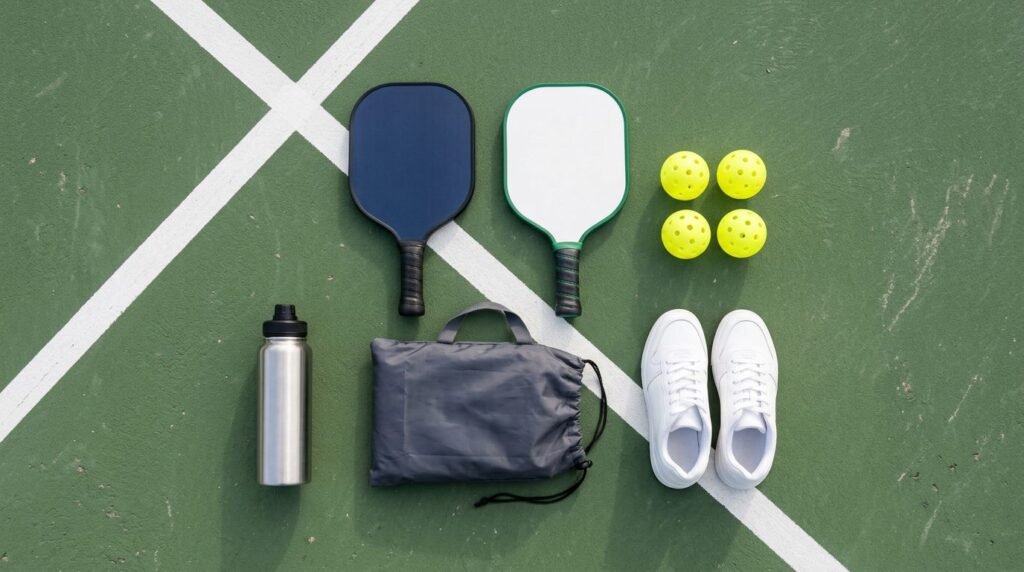
A starter paddle set
A set with two USA Pickleball approved paddles, outdoor balls and a carry case gets you and a partner playing without guessing at specs. Fiberglass faces like the ones in this set are forgiving for new players.
Outdoor balls
Outdoor balls are harder, heavier and have smaller holes than indoor balls, so they fly true in the wind. The Franklin X-40 is one of the most widely used outdoor balls and is approved for USA Pickleball play.
A portable net
A regulation-size portable net turns a driveway, tennis court or parking lot into a pickleball court. The Pickle-Ball SwiftNet 2.1 is a portable net system that sets up without tools and packs away for storage.
For shoes, wear court shoes made for side-to-side movement, such as tennis or pickleball shoes. Running shoes are built for forward motion and roll easily on quick lateral steps.
FAQ
Can you hit the ball before it bounces?
Yes, once the ball has bounced once on each side after the serve. You just can’t do it while you’re standing in the kitchen or touching its line.
Can the serve hit the net?
Yes. If the serve touches the net and lands in the correct service court, it’s in play. If it lands in the kitchen or out of bounds, it’s a fault.
Can you step in the kitchen?
Yes. The only thing you can’t do in the kitchen is volley. You can stand there and play balls that have bounced.
Is pickleball scored like tennis?
No. Points simply go up by one, games are usually played to 11, and you need to win by 2. In traditional scoring only the serving team scores.
Rules are updated each year. For tournament play, check the official rulebook at USA Pickleball.